The cold cap system

|
The cold cap system |
|
| Home | Site map | Lifestyle and cancer | Treatments | Contact us |
|
| Contents and links: Lifestyle news | About cancer | Chemotherapy | Radiotherapy | Hormone therapy | Biological therapies | Complementary therapies | Coping with side effects | Clinical trials | After cancer-survivorship | Travelling and cancer | Specific cancers | About us | Site map | | |
Prevention of hair
loss
Preventing as much of the chemotherapy
drug getting to your scalp as possible
 can do this. This is done using a cold
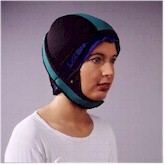
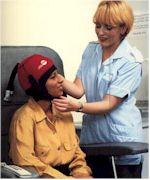
cap that acts to cool the scalp and therefore restrict blood circulating in that
area and reaching the follicles. The availability and types of cold cap used
varies from hospital to hospital. The cap put on fifteen minutes before
chemotherapy to start restricting blood flow, and kept on during and up to 1-2 hours after your chemotherapy.
This does mean that your time in the unit is longer.
can do this. This is done using a cold
cap that acts to cool the scalp and therefore restrict blood circulating in that
area and reaching the follicles. The availability and types of cold cap used
varies from hospital to hospital. The cap put on fifteen minutes before
chemotherapy to start restricting blood flow, and kept on during and up to 1-2 hours after your chemotherapy.
This does mean that your time in the unit is longer.
Not everyone can tolerate wearing the cold cap as it can feel very cold. It also increases the time spent in the chemotherapy unit as it must be worn for a little time after the infusion of drugs has finished. This discomfort varies from patient to patient so it is not a failure if you can't wear it and it has no influence on the outcome of your treatment. In a clinical trials to date, however, less than 2% of patients who had retained their hair did not continue with the procedure.
The cold caps are effective in preventing hair loss for most chemotherapy drugs. Some individuals however still loose their hair despite using it and some drugs are more likely to cause hair loss than others (see table below). Your doctor or nurse will be able to advise you.
How it works?
Studies have shown that scalp cooling is effective in
preventing hair loss in patients treated with some chemotherapy
drugs. Cooling the scalp
to a temperature of +17 oC to achieve a subcutaneous temperature of
+20 0C (68 oF) constricts the blood supply to hair follicles diminishing or
abolishing their perfusion hence preventing high chemotherapy dose delivery during
the initial phase of chemotherapy. Further, coldness itself reduces the
availability of (chemotherapy) cytotoxic drugs to the cells of the hair follicles by directly
reducing their metabolic rate. It is the combined effect of both these
mechanisms, induced by cooling the scalp, that prevents or reduces hair loss (alopecia).
How effective is it?
The cold cap system works better for some drugs than others.
Clinical trials show a success rate of
up to 85% with Docetaxel (taxotere), Epirubicin, Cyclophosphamide, Paclitaxel
(Taxol) and many other drugs which as seen in the table below do normally cause
hair loss without it., :-
Drugs
which cause hair loss without the cold cap
|
Drugs which usually do cause hair loss |
Drugs which sometimes cause hair loss |
Drugs which usually don't cause hair loss |
| Adriamycin | Amsacrine | Methotrexate |
| Daunorubicin | Cytarabine | Carmustine(BCNU) |
| Etoposide | Bleomycin | Mitroxantrone |
| Irinotecan (Campto) | Busulphan | Mitomycin C |
| Cyclophosphamide | 5 Fluorouracil | Carboplatin |
| Epirubicin | Melphalan | Cisplatin |
|
Docetaxel, (Taxotere) |
Vincristine | Procarbazine |
| Paclitaxel, (Taxol) | Vinblastine | 6-Mercaptopurine |
| Ifosphamide | Lomustine(CCNU) | Sreptozotocin |
| Vindesine | Thiotepa | Fludarabine |
| Vinorelbine | Gemcitabine | Raltitrexate (Tomudex) |
| Topotecan | Capecitabine |
Find out more about
cold caps:-
Links and further resources: Glossary
| About us |
Disclaimer |
Contact us
| How
to advertise on this site

 What
is cancer; About
specific cancers;
Breast |
Prostate |
Bowel. Cancer
treatments; Chemotherapy
|
Radiotherapy |
Hormones | Biological
agents | Complementary.
Lifestyle
advice;
Exercise | Diet |
Smoking | Sunbathing
| Alcohol. Cope
with symptoms; Traveling
| Insurance | Making
a will | Support groups
| Tests
for cancer | Clinical trials. ...site
map
What
is cancer; About
specific cancers;
Breast |
Prostate |
Bowel. Cancer
treatments; Chemotherapy
|
Radiotherapy |
Hormones | Biological
agents | Complementary.
Lifestyle
advice;
Exercise | Diet |
Smoking | Sunbathing
| Alcohol. Cope
with symptoms; Traveling
| Insurance | Making
a will | Support groups
| Tests
for cancer | Clinical trials. ...site
map
 An
excess or a deficiency of vitamins and trace mineral can lead to an
increased risk of cancer, other illnesses and troublesome symptoms. A reliable way to ensure you have
the correct amounts is to measure
them. You will then be a to make able to make informed dietary decisions including and whether to take specific supplements
in order to restore your nutritional balance. ...read
more / order online
An
excess or a deficiency of vitamins and trace mineral can lead to an
increased risk of cancer, other illnesses and troublesome symptoms. A reliable way to ensure you have
the correct amounts is to measure
them. You will then be a to make able to make informed dietary decisions including and whether to take specific supplements
in order to restore your nutritional balance. ...read
more / order online
 The
first
broad spectrum anti oxidant rich super food designed by a leading oncologist.
POmi-T
aims to boost your daily
antioxidant levels using only carefully selected natural wholes foods
which have been dried and concentrated for convenience ...read
more / order.
The
first
broad spectrum anti oxidant rich super food designed by a leading oncologist.
POmi-T
aims to boost your daily
antioxidant levels using only carefully selected natural wholes foods
which have been dried and concentrated for convenience ...read
more / order.
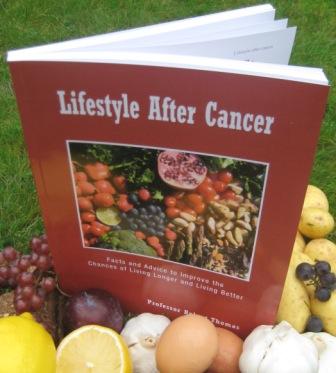
 An inspiring new lifestyle advice
book, based only on the
facts, empowers readers with the knowledge to help their chances of living longer and stronger
..read
more / order
Después de una diagnosis del cáncer, es; “Qué puede nosotros hacer para
ayudarse?” La respuesta, que este libro trata, está “mucho”.
order
online
An inspiring new lifestyle advice
book, based only on the
facts, empowers readers with the knowledge to help their chances of living longer and stronger
..read
more / order
Después de una diagnosis del cáncer, es; “Qué puede nosotros hacer para
ayudarse?” La respuesta, que este libro trata, está “mucho”.
order
online
 This
little book
identifies the situations where arguments
breakout and
gives simple tips to navigate around
them. Ideal reading for families after
cancer ..
order online
This
little book
identifies the situations where arguments
breakout and
gives simple tips to navigate around
them. Ideal reading for families after
cancer ..
order online
 This
21 minute DVD explains chemotherapy & radiotherapy. The only
preparatory film which was evaluated in a randomised study and
shown to reduce anxiety and improve well-being during treatments. Available in English, Italian, Urdu,
Bengali, Gujarati & Hindi ... read more / order online
This
21 minute DVD explains chemotherapy & radiotherapy. The only
preparatory film which was evaluated in a randomised study and
shown to reduce anxiety and improve well-being during treatments. Available in English, Italian, Urdu,
Bengali, Gujarati & Hindi ... read more / order online
 Cracked and sore lips are
common during chemotherapy and afterwards. There is evidence that
natural oil based creams are better than petroleum based creams. Nature-medical
lip balm contains only natural waxes and essential oils selected for their anti-inflammatory
and DNA stabilizing properties.. read
more..order
Cracked and sore lips are
common during chemotherapy and afterwards. There is evidence that
natural oil based creams are better than petroleum based creams. Nature-medical
lip balm contains only natural waxes and essential oils selected for their anti-inflammatory
and DNA stabilizing properties.. read
more..order