






|
||||||||||||||
|
A Guide to Stereotatic Radiosurgery |
||||||||||||||
There are two forms of stereotactic radiotherapy. There is Stereotactic Radiosurgery and Stereotactic Radiotherapy. For information on Stereotactic Radiosurgery, please see the page below. For information on Stereotactic Radiotherapy, please see Stererotactic RadiotherapyIntroduction Stereotactic
radiosurgery is a very precise treatment to a small area of the brain. To ensure
that the treatment position is reproduced accurately you will need to have a
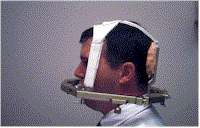
special frame made. The majority of patients find the head frame reasonably
comfortable to wear. 1.
It
enables accurate reproducibility of the treatment position for each planning and
treatment session. 2.
It
prevents movement of your head during the treatment 3.
It
removes the need for ink marks on your head or face. First visit
Making
the mouth bite: The
frame is then secured into place by straps across your head. Second visit The
Oncologist will use the information from this scan to plan your radiotherapy and
this process normally takes a couple of weeks.
Third visit Treatment: Treatment is given in one of the radiotherapy treatment rooms. At each treatment
the head frame will be fitted and Whilst
the machine is switched on the radiographers will leave the room but will be
watching you on close circuit TV. They can stop the treatment at any time. You
will not feel anything during treatment but may be aware of a buzzing sound. The
treatment is divided into several fields with the treatment machine positioned
slightly differently for each. Each treatment field takes about one minute and
the radiographers will come into the treatment room between fields. The whole
treatment takes about 20 minutes to deliver. Each week throughout the course of your treatment you will have an opportunity to see either the doctor or a specialist radiographer to discuss any problems or queries that arise. The radiotherapy will not make you ill and you will be well enough to travel. You may or may not be allowed to drive yourself. This should be discussed with you doctor prior to treatment. Medication If you are currently taking steroids, the dose is often kept at the same level between leaving hospital after your operation and starting radiotherapy. This dose may be adjusted during your radiotherapy following discussion with the doctor. Side effects Any side effects vary from person to person. The type and site of your tumour may also determine the side effects you experience. The most common side effects you may experience are listed below: Hair loss Unfortunately
you will lose your hair in the area being treated. This normally happens two to
three weeks after the commencement of the radiotherapy. We try to arrange
treatment so that your hair will re-grow, but your treatment will never be
compromised for the sake of keeping your hair. Hair can take a long time to
re-grow following radiotherapy. A wig can be organised for you if required. Skin
The skin in the treatment area may gradually redden from the second week of
treatment onwards. It may become dry, itchy and sore especially around the ears
if they are in the treatment area. To minimise dryness and irritation aqueous
lotion may be used in the treatment area. During the summer months the area
should be protected from the sun to prevent sun damage. Any reaction will soon
clear up after treatment has finished. Tiredness This
side effect varies greatly from person to person. Generally it increases
throughout the radiotherapy and may last for a few weeks after completion of
your treatment (see information on coping with fatigue). Pituitary function
In
some patients the pituitary gland may receive a dose of radiotherapy, this may
affect the gland and its hormone production. If it occurs, this happens a year
or more after radiotherapy, and is easily managed. If this side effect applies
to you, the team will explain it fully. The doctor or radiographer giving the treatment will be happy to answer any questions you may have about the treatment and can be contacted during working hours at the telephone number given on your appointment card. Appointment, Appointments Date, Frame Making, CT Scan, Frame Fitting You will be given a separate appointment card for radiotherapy treatment dates and times. Further general information Your doctors and specialist nurses are in an ideal position to give you relevant information on your disease and treatment as they know your individual circumstances. Cancerbackup has a help line (0808 800 1234) and a prize winning video available in English, Italian, Urdu, Bengali, Gujarati & Hindi explaining Radiotherapy & Chemotherapy. Cancernet.co.uk has over 500 pages describing cancer, its management, practical tips and tool which patients, their carers and their doctors have found helpful during the cancer journey. |
||||||||||||||


 Once
the frame has been made and is fitting well we do some measurements to ensure
that the frame can be relocated in the same position at each visit. To take the
measurements we use a clear plastic helmet, called a depth helmet and a
measuring probe. These measurements are taken with you lying down so that you
are in the same position as you will be for your treatment. Two or more sets of
measurements will be done on your first visit. Further sets of measurements will
be taken before any planning or treatment.
Once
the frame has been made and is fitting well we do some measurements to ensure
that the frame can be relocated in the same position at each visit. To take the
measurements we use a clear plastic helmet, called a depth helmet and a
measuring probe. These measurements are taken with you lying down so that you
are in the same position as you will be for your treatment. Two or more sets of
measurements will be done on your first visit. Further sets of measurements will
be taken before any planning or treatment. 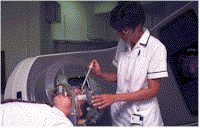 At
this appointment a CT scan will be taken of you positioned in the head frame.
During the scan you may be given an injection of contrast: this is a dye that
helps to highlight the area needing treatment. The appointment usually lasts
about 30 minutes.
At
this appointment a CT scan will be taken of you positioned in the head frame.
During the scan you may be given an injection of contrast: this is a dye that
helps to highlight the area needing treatment. The appointment usually lasts
about 30 minutes. 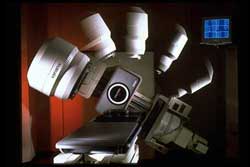 measurements taken to ensure that it has been
located correctly. You will be positioned for treatment using the room lasers
and lights.
measurements taken to ensure that it has been
located correctly. You will be positioned for treatment using the room lasers
and lights.