 Healthy
eating and cancer
Healthy
eating and cancer |
| Find out more about:- | ||
| A balanced diet | Fruit & Veg | Meat & fish |
| Fatty foods | Fibre | |
| Soya & phyto-oestrogen | Carotenoids | Minerals |
| Bread, Potatoes& cereals | Snacks | Food additives |
A
well
balanced healthy diet does not guarantee to prevent cancer, but it can reduce your
likelihood of developing it.
Some researchers estimate that we could reduce 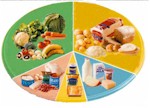 the
incidence of some types of cancer by up to a third if we all ate more
healthily. Diet has been linked to several types of cancer including:-
the
incidence of some types of cancer by up to a third if we all ate more
healthily. Diet has been linked to several types of cancer including:-
Breast / Lung
Bowel / Stomach
Prostate / Pancreas
Oesophagus / Bladder
Most of us would be able to change our diet in some way to make it healthier. An expert working group (COMA, Department of Health) reviewed the current research in 1998 and recommend to eat more healthily we should consider the proportions of food in the adjacent picture. For most people this means:-
Eat more fruit and vegetables
Eat more fibre
Cut down on meat intake
Using alternative sources of protein
Cut down on fat
Cut down on salt
Cut down on sugar
Although there is no single food we should omit studies of different groups of people, and their diets, have
shown that eating large or frequent amounts of certain types of food increases the chances
of developing certain cancers:-
Pickled or salted vegetables - linked with gastric (stomach) cancer in China and
Japan
Smoked food - linked to stomach cancer.
Strong alcohol - linked to cancer of the mouth
Excess alcohol - linked to breast & bowel cancer
All adults should aim to eat an average of 5 portions a day. A portion is:-
| apple, orange or banana | 1 fruit |
| very large fruit e.g. melon, pineapple | 1 large slice |
| small fruits e.g. plums, kiwis, satsumas | 2 fruit |
| raspberries, strawberries, grapes | 1 cupful |
| fresh fruit salad, stewed or canned fruit | 2-3 tablespoonfuls |
| dried fruit | ½-1 tablespoonful |
| fruit juice | 1 glass (150mls) |
| vegetables, raw, cooked, frozen or canned | 2 tablespoonfuls |
| salad | 1 dessert bowlful |
The evidence so far says that vitamin supplements or fortified foods are not as effective as eating more fruit and vegetables.
It is recommended that people who eat large amounts, more than 140g or 5-6oz day, should reduce this, and that if meat is eaten, people should aim for approximately 90g/3oz per day. Meat is a valuable source of iron and other nutrients and it is essential that, if you cut down or avoid meat, you should substitute other iron rich foods, e.g. lentils, eggs, oily fish, to ensure the diet is balanced. Fish, and particularly oily fish e.g. sardines, pilchards, salmon and mackerel, have particular benefits to health; try to have them twice a week. Beans, lentils and pulses, like meat, are rich in protein and provide some iron. If you are following a vegetarian or vegan diet, it is important that you eat a portion of these most days.
Bread, cereals and potatoes:
Eating more of these foods will help reduce the likelihood of developing bowel cancer. Choose the higher fibre foods e.g. wholemeal bread, high fibre cereals (e.g. branflakes, wheatflakes, Weetabix, Shredded Wheat).
If you are hungry at mealtimes, eat larger quantities of these
foods, for example, have an extra potato or spoonful of rice or chapatti. Choose thick cut
bread.
It is generally recommended to cut down on fat to eat a healthy diet. However, regularly eating foods high in fat e.g. pies, rich cakes, cream, can lead to overweight and obesity. This can increase your chances of developing some cancers. For general good health, eat high fat foods less often and in smaller portions.
Vitamins and
minerals
If you have a healthy diet it is generally unecessary to supplement your diet with
vitamin and minerals. If taken in excess supplements could actually be harmful. If
however, your apetite is poor or you have not been eating well there may be a useful role
for supplements
.
Dietary fibre
In most European countries, the consumption of dietary fibre has been estimated to be
around 20g per day. An increased daily intake, to approximately 30g, is encouraged to
promote health benefits associated with fibre.
Research indicates that eating fibre helps to protect against a number of disorders of the digestive tract such as constipation, diverticular disease, haemorrhoids and possibly cancer of the large bowel. In addition fibre-rich foods are ideal for weight control since they are filling but low in calories. Certain types of fibre in a meal slow down the uptake of sugars. Therefore, they play an important part in the diet of may diabetics.
The digestion of fibre? Dietary fibre passes through the stomach and the small intestine without being digested, whereas it can be extensively fermented by the bacteria in the large bowel. During transit in the small intestine, fibre can interact with other nutrients and influence their uptake. These interactions can explain many of the beneficial effects of fibre. The end-products of fermentation are short fatty acids. These are nutrients for the large bowel (butyric acid) or are used as energy source by the liver and the muscles. Butyric acid seems to be involved in a number of beneficial effects in the large bowel.
What is fibre good for? Regulation of blood sugar and risk of diabetes (type II or non-insulin dependant diabetes).Low glycaemic index foods (slow carbohydrates, often rich in dietary fibre) are important in the management of diabetes. They probably also help in the prevention of diabetes and related disease (obesity, cardiovascular diseases).
Prevention
and treatment of obesity The presence of fibre
in food reduces its energy density. Obese people on a low energy diet feel less hungry
when they eat fibre-rich food.
Regulation of blood lipids and prevention of cardiovascular disease (CDV) There is general agreement that a daily decrease in cholesterol would be
beneficial for health and especially against CVD. Several fibre sources are able to reduce
blood lipid response to a meal by different mechanisms, for example in increased excretion
of cholesterol and bile acids or a decrease in insulin secretion.
Prevention of bowel cancer Several studies indicate there may be a reduction of the incidence of bowel cancer by increasing the intake of dietary fibre. Much work has been carried our on the validation of markers of cancer development. These markers will help to find good fibre sources for food and medical used to prevent bowel cancer. Some fibres seem to be able to reduce cancer risks by stimulating the production of butyric acid. This may then stimulate the immune systems to protect against cancer. The same fibres can also stimulate the growth of Bifidobacteria. These bacteria have been associated with health promotion.
Prevention of constipation
Insoluble fibre (e.g. coarse wheat bran) is efficient to regulate
transit. Secondary effects are the prevention of haemorrhoids and diverticular disease.
Insoluble fibre acts mainly through bulking effects and stimulation of motility in the
large bowel.
What about the risk of osteoporosis associated with a high intake of dietary fibre?
An adverse effect of dietary fibre on osteoporosis in elderly people
has been suggested. It is still hypothetical and not supported by science or epidemiology.
What are carotenoids? This is a large group of yellow, orange and red plant pigments. Foods that contain these pigments form a large part of the healthy Mediterranean diet. Along with vitamins E and C, carotenoids are antioxidants, and research indicates that an optimal intake of these important nutrients may help delay or prevent the onset of cancer, heart disease, cataracts and other major disease. The most significant of the most common carotenoids are thought to be
- Beta-carotene
- Alpha-carotene
- Cryptoxanthin
- Zeaxanthin
- Lycopene
- Lutein
How do carotenoids work? Carotenoids are perhaps best known for their ability to be converted to vitamin A, which is essential for healthy vision and reproduction, and for maintaining body tissues. Around 10% of carotenoids, including alpha carotene, cryptoxanthin and beta-carotene, are able to do this. Independent of any ‘pro-vitamin A’ function they might have, carotenoids are also powerful antioxidants.
Antioxidants provide protection from dangerous molecules called free radicals which can be formed from damage to body cells from the sun, tobacco smoke, car exhaust fumes and pesticides as well as the body’s normal metabolic processes.
It is thought that the most effective protection from carotenoids comes from mixing your carotenoids, rather than large doses of single carotenoids.
Examples of the different types of carotenoids
Lycopene West food sources: tomatoes, watermelon and pink grapefruit
Probably the most effective scavenger of single oxygen, a type of
free radical. Research shows that a high consumption of tomatoes and tomato products is
thought to lower the risk of prostate, stomach and lung cancer. Sue Southon, professor at
the Institute of Food Research in Colney, said studies at the centre should the highest
levels of lycopene is in processed tomato products rather than fresh produce.
‘We’ve found that the lycopene in prepared tomatoes such as in tomato paste,
tinned tomatoes or ketchup will be absorbed more easily by the body. The evidence is that
5-7mg of lycopene each day will help and this can be found in a tin of tomatoes or a
couple of tablespoons of tomato paste’. Two or three fresh, ripe tomatoes each day
would produce the same results.
Lutein and Zeaxanthin Best food sources: spinach,
red pepper, peas, kale, broccoli and celery
There is thought to be a link between a diet high in these
vegetables and a lower risk of Age-related Macular Degeneration (AMD), a serious eye
disease that can cause irreversible blindness.
Cryptoxanthin West food sources: oranges,
papaya, peaches and tangerines
A study has found that women with cervical cancer have very
low blood levels of this carotenoid.
Alpha Carotene Best food sources:
carrots and pumpkins
Research on vegetable intake and lung cancer has found a strong
association between a low intake of vegetables and alpha carotene and a higher incidence
of lung cancer among smokers.
Beta Carotene Best food sources: carrots,
peaches, apricots, spinach and cantaloupe
The most abundant carotenoid in the diet, and also the most effective at converting to vitamin A. Numerous studies support its protective role in human health: higher intake of beta carotene has been associated with a lower risk of a range of cancers, including oral, lung, breast, oesophageal, stomach and cervical cancer.
The latest findings on beta-carotene include those of a group of
Norwich researchers who have identified a potential mechanism for beta carotene’s
apparent anti-cancer properties. A recent German study has found that beta-carotene
supplements significantly enhanced skin protection against UV light, when combined with
topical sunscreens.
How much should I be eating? Professor
Anthony Diplock, President of the International Antioxidant Research Centre, estimates the
levels of beta carotene associated with the lowest risk of disease to be between 8 and
10mg a day. However, research has shown that the average intake of beta-carotene in the UK
is only 2mg a day. Part of the reason for this may be that many of us are failing to eat
the five-a-day servings of fruit and vegetables recommended by experts. MAFF reports that
fresh fruit and vegetables consumption in the UK has dropped 30% since 1970. At the same
time, our exposure to free radicals from pollution and UV radiation has grown
considerably, increasing our need for antioxidants.
Should I take a supplement? Increasing
the fruit and vegetables in your diet is the ideal way of ensuring an adequate carotenoid
intake. If you eat five portions of fruit and vegetables a day, then you should not have
to take supplements as well.
Is there any difference between natural and synthetic carotenoid supplements?
Natural carotenoid supplements are extracted from plant sources such
as palm oil, or Dunaliella salina, marine algae, which grows abundantly in Australian
seawaters. Natural supplements from D. salina contain several nutritionally valuable
carotenoids, providing a rich mixture similar to that found in fruit and vegetables.
Synthetic carotenoid supplements contain only beta-carotene.
While beta-carotene remains an important carotenoid, evidence now supports the ideas that
a variety of different carotenoids are the most effective at quenching free radicals.
Can I take supplements with medicines? If you have a medical condition or are taking any form of medication,
always check with your doctor before taking any supplements.
Eat a balance of foods in roughly the proportions shown on the plate below:-
Snacks between meals If you are hungry between meals have:-
- toast / bread
- teacakes
- Crumpets
- English muffins (American are higher in fat!)
- Scones
- Scotch pancakes
Try to use only a little margarine or butter.
If you want to make some changes to your diet, make small gradual changes. For example, if you eat crisps daily, cut them down to 3-4 times a week and choose a healthy snack instead.
Soya foods and other phyto-oestrogensPhyto-oestrogens are chemicals which are found in plant foods (phyto means 'plant'). They are similar in structure to the female sex hormone oestrogen. There are different types of Phyto-oestrogens, to find out more on phyto-oestrogens See - "Your Health in Your Hands". Some are found in soya bean products. Others are found in the fibre of whole grains, fruit, vegetables and flax seed. Milk may also contain Phyto-oestrogens, but this depends on what the cows have been eating! Some early research has suggested that women whose diets are high in Phyto-oestrogens have a lower risk of breast cancer. In some studies eating Phyto-oestrogens (soya flour and linseed supplements) regularly over several weeks reduced oestrogen levels. The HRT cake has been designed to carry ingredients with high phytoestrogen levels and is therefore good for hot flushes and preventing breast cancer:-
Calories,
obesity and breast cancer
Obese women are more likely to get breast cancer.
'Obese' means more than 40% overweight.
We do not know exactly why this is, although there are some theories.
Populations of women at higher risk of getting breast cancer are often found to have higher oestrogen levels than populations with lower breast cancer risk. After the menopause, oestrogen is converted into its active form in the body fat. So obese postmenopausal women could have higher oestrogen levels and so have a higher risk of breast cancer.
Food
additives
Many things come under the general heading of
food additives including
|
|
|
There is no research to suggest that food additives are a risk factor for breast cancer. Most food additives actually help reduce the risk of cancer by stopping food going mouldy for example.
There has been concern about saccharine in the past. But it has not been shown to cause cancers in people, only in laboratory animals. Even so, in the food industry other sweeteners have mostly replaced it.
Pesticides
Pesticides have been linked to breast cancer,
Lindane for example. Lindane is widely used in some areas of the UK where there
is a lot of farming such as Lincolnshire. Some environmental groups have linked
high local rates of breast cancer with Lindane use. But there is not much
scientific evidence to link the two as yet. What there is, is very
contradictory. It is a good idea to wash all fruit and vegetables before use so
that you remove any pesticides that are left on the skin.
Alcohol
and breast cancer
Alcohol is known to increase the risk of some
cancers. Some research studies show that drinking a lot can increase risk of
breast cancer. Other research studies don't show such a risk. There are a few
researchers and breast cancer doctors who are convinced that drinking does
increase risk even though they don't really have the evidence to prove it.
Others think it may when combined with other factors such as using hormone
replacement therapy. Basically we don't know. But too much alcohol has so many
other bad effects on our health and welfare that it is sensible not to drink too
much. There is no evidence that low levels of alcohol consumption are harmful,
however.
Remember - Enjoy your food!
Please note: Please note: These recommendations do NOT apply to young children. Please note: These recommendations do NOT apply to young children.
These recommendations do NOT apply to young children.