





|
||||||||||||||
|
Lifestyle and cancer |
||||||||||||||
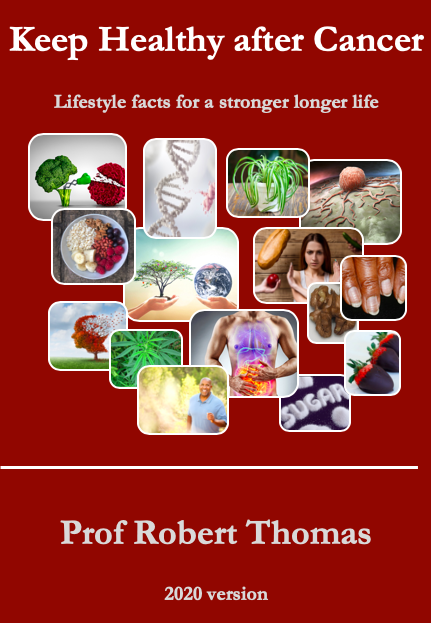
This section offers practical lifestyle guidance to reduce cancer risks and improve well-being. This evidence and practical advice has also been summarised in a book entitled Lifestyle after Cancer. Well conducted international evidence leaves no doubt that what we choose to do and don't do to our bodies can influence cancer in a number of ways:
Lifestyle
factors to reduce cancer development and reduce risk of relapse What to do more of:
What to do less of:
Side effects which can be influenced by lifestyle and self help strategies During treatment:
Other lifestyle issues: 
When to consider a lifestyle initiative. Shortly after their diagnosis, patients and their relatives are confronted by a sudden commotion activity usually traveling to the hospital for blood tests, x-rays, scan, biopsies, and treatments. This causes enormous upheaval to the daily routine both socially and at the work place. Most of your time is taken up adjusting to their new diagnosis, with coping with the side effects of therapy and the difficulties of remembering, where and when they have to be and what to do when they get there! Forcing yourself into a strategy which you cannot do for practical or physical reasons would be inappropriate or at worse may project a feeling of guilt which is counter productive. Depending on the individual circumstances, at an early point in the treatment pathway, however, the subject could be introduced gradually and sensitively. The timing is paramount, as is ability of the clinician to assess the patient’s receptiveness to considering lifestyle issues at each stage. Too early and the anxieties of the circumstances will be confounded, too late and the benefits of lifestyle will be overlooked. 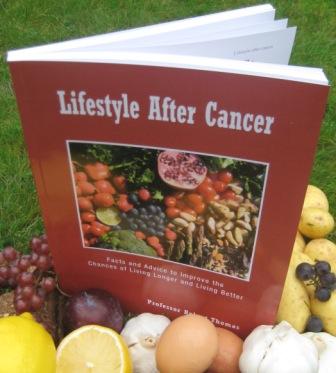 Further
information
The book Lifestyle
After Cancer summarises the lifestyle evidence from around the
world and provides practical advice for all stages of the cancer journey. Cancerbackup
has a help line (0808 800 1234) and a detailed video
available in English, Italian, Urdu, Bengali,
Gujarati & Hindi explaining Radiotherapy & Chemotherapy. Cancernet.co.uk
is a comprehensive cancer information resource written by an experienced team of
doctors, health professionals and patients. It contains links and information
on: Specific cancers:
Breast |
Prostate |
Bowel. Cancer
treatments: Chemotherapy |
Radiotherapy |
Hormones | Biological
agents | Complementary
therapies . Lifestyle and cancer:
Exercise | Diet |
Smoking | Sunbathing
| Alcohol. Tips to help
with the symptoms and side effects. Financial issues:
Traveling | Travel
insurance| Links to support groups
| Books | Tests
for cancer | Clinical trials | What
is cancer | How to avoid cancer | Glossary
| About us | Disclaimer Further
information
The book Lifestyle
After Cancer summarises the lifestyle evidence from around the
world and provides practical advice for all stages of the cancer journey. Cancerbackup
has a help line (0808 800 1234) and a detailed video
available in English, Italian, Urdu, Bengali,
Gujarati & Hindi explaining Radiotherapy & Chemotherapy. Cancernet.co.uk
is a comprehensive cancer information resource written by an experienced team of
doctors, health professionals and patients. It contains links and information
on: Specific cancers:
Breast |
Prostate |
Bowel. Cancer
treatments: Chemotherapy |
Radiotherapy |
Hormones | Biological
agents | Complementary
therapies . Lifestyle and cancer:
Exercise | Diet |
Smoking | Sunbathing
| Alcohol. Tips to help
with the symptoms and side effects. Financial issues:
Traveling | Travel
insurance| Links to support groups
| Books | Tests
for cancer | Clinical trials | What
is cancer | How to avoid cancer | Glossary
| About us | Disclaimer
|
||||||||||||||


 The
factors which influence the risk of developing cancer and those which influence
its relapse are similar. These have been summarised in the sections "What to do
more of" and "what to do less of" below. The lifestyle strategies which can reduce
risks and help you cope with side effects are listed in the individual heading
below. They have been split into strategies to help with risks and side effects during
cancer treatments and those which help speed up recovery and help the long term
risks and side effects.
The
factors which influence the risk of developing cancer and those which influence
its relapse are similar. These have been summarised in the sections "What to do
more of" and "what to do less of" below. The lifestyle strategies which can reduce
risks and help you cope with side effects are listed in the individual heading
below. They have been split into strategies to help with risks and side effects during
cancer treatments and those which help speed up recovery and help the long term
risks and side effects.

 After
treatment (long term):
After
treatment (long term):